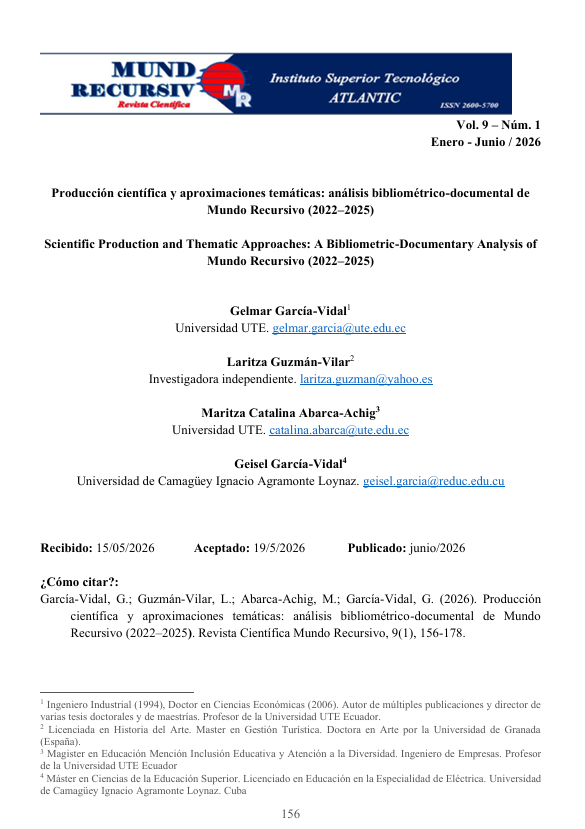
Scientific Production and Thematic Approaches: A Bibliometric-Documentary Analysis of Mundo Recursivo (2022–2025)
Keywords:
educational bibliometrics, scientific production, thematic analysis, Latin American journals, educational sciencesAbstract
This study presents a bibliometric-documentary analysis of the scientific journal Mundo Recursivo covering the period 2022–2025, with the aim of characterizing its scientific output, authorship structure, predominant thematic clusters, and contribution to the debate in educational sciences. The corpus comprises 40 articles distributed across four volumes (Vol. 5, No. 2 through Vol. 8, No. 1). Production indicators, institutional collaboration, geographic distribution, methodological diversity, keyword frequency, co-authorship networks, and predominant theoretical frameworks were examined through descriptive bibliometric techniques complemented by inductive-deductive content analysis. Inter-rater agreement between two independent coders reached 87.5% in the first iteration and 95% in the third. Results reveal a stable output (M = 10 articles per issue; CV = 8.7%), a network of 88 authors from 12 institutions in Ecuador and Cuba, a collaboration index of 3.2 authors per article, and a co-authorship network of 90 nodes and 143 edges (density = 0.036). The corpus is organized into five knowledge clusters: emerging technologies and artificial intelligence; environmental education and sustainability; psychopedagogy and special needs; risk management and university quality; and professional training with active methodologies. Evolutionary analysis documents a thematic transition from classical curriculum design (2022) toward artificial intelligence, student well-being, and complex environmental governance models (2025). Four epistemological tensions were identified through systematic thematic analysis of recurring contradictions between pedagogical postulates, methodological approaches, and conclusions present in the corpus, each documented in three or more articles. The study contributes evidence on the role that regional open-access journals play in the construction of Latin American pedagogical knowledge.
References
Ainscow, M. (2020). Inclusion and equity in education: Making sense of global challenges. Prospects, 49(3–4), 123–134. https://doi.org/10.1007/s11125-020-09506-w
Alperin, J. P., & Rozemblum, C. (2017). La reinterpretación de visibilidad e impacto en la nueva geopolítica del conocimiento. Revista Interamericana de Bibliotecología, 40(3), 231–241. https://doi.org/10.17533/udea.rib.v40n3a04
Ausubel, D. P. (1963). The psychology of meaningful verbal learning. Grune & Stratton.
Barrows, H. S. (1986). A taxonomy of problem-based learning methods. Medical Education, 20(6), 481–486. https://doi.org/10.1111/j.1365-2923.1986.tb01386.x
Beigel, F. (2014). Publishing from the periphery: Structural heterogeneity and segmented circuits. Current Sociology, 62(5), 743–765. https://doi.org/10.1177/0011392114533977
Braun, V., & Clarke, V. (2006). Using thematic analysis in psychology. Qualitative Research in Psychology, 3(2), 77–101. https://doi.org/10.1191/1478088706qp063oa
Brunner, J. J., & Villalobos, C. (2014). Políticas de educación superior en Iberoamérica, 2009–2013. Ediciones Universidad Diego Portales.
Carayannis, E. G., & Campbell, D. F. J. (2009). "Mode 3" and "Quadruple Helix": Toward a 21st century fractal innovation ecosystem. International Journal of Technology Management, 46(3–4), 201–234. https://doi.org/10.1504/IJTM.2009.023374
Cetto, A. M., & Alonso-Gamboa, J. O. (1998). Scientific periodicals in Latin America and the Caribbean: A global perspective. Interciencia, 23(2), 84–93.
Cuban, L. (2001). Oversold and underused: Computers in the classroom. Harvard University Press.
Etzkowitz, H., & Leydesdorff, L. (1995). The triple helix: University-industry-government relations. EASST Review, 14(1), 14–19.
García-Guadilla, C. (2013). Universidad, desarrollo y cooperación en la perspectiva de América Latina. Revista Iberoamericana de Educación Superior, 4(9). https://doi.org/10.22201/iisue.20072872e.2013.9.81
Glanzel, W., & Schubert, A. (2005). Domesticity and internationality in co-authorship, references and citations. Scientometrics, 65(3), 323–342. https://doi.org/10.1007/s11192-005-0277-0
González-Gaudiano, E. (2007). Schooling and environment in Latin America in the third millennium. Environmental Education Research, 13(2), 155–169. https://doi.org/10.1080/13504620701284621
Hallinger, P., & Heck, R. H. (2011). Exploring the journey of school improvement: classifying and analyzing patterns of change in school improvement processes and learning outcomes. School Effectiveness and School Improvement, 22(1), 1–27. https://doi.org/10.1080/09243453.2010.536012
Hallinger, P., & Kovačević, J. (2019). A bibliometric review of research on educational administration: Science mapping the literature, 1960 to 2018. Review of Educational Research, 89(3), 335–369. https://doi.org/10.3102/0034654319830380
Hmelo-Silver, C. E. (2004). Problem-based learning: What and how do students learn? Educational Psychology Review, 16(3), 235–266. https://doi.org/10.1023/B:EDPR.0000034022.16470.f3
Miguel, S. (2011). Revistas y producción científica de América Latina y el Caribe: su visibilidad en SciELO, RedALyC y SCOPUS. Revista Interamericana de Bibliotecología, 34(2), 187–199.
Morin, E. (1990). Introduction à la pensée complexe. ESF Éditeur.
Nonaka, I., & Takeuchi, H. (1995). The knowledge-creating company. Oxford University Press.
Packer, A. L., Cop, N., Luccisano, A., Ramalho, A., & Spinak, E. (orgs.). (2014). SciELO – 15 Years of Open Access: An analytic study of Open Access and scholarly communication. UNESCO.
Piaget, J. (1954). The construction of reality in the child. Basic Books.
Pritchard, A. (1969). Statistical bibliography or bibliometrics? Journal of Documentation, 25(4), 348–349.
Qi, J., & Ha, A. S. (2012). Inclusion in physical education: A review of literature. International Journal of Disability, Development and Education, 59(3), 257–281. https://doi.org/10.1080/1034912X.2012.697737
Moed, H. F. (2005). Citation Analysis in Research Evaluation. Springer. ISBN 978-1-4020-3713-9. https://doi.org/10.1007/1-4020-3714-7
Rozemblum, C., Unzurrunzaga, C., Banzato, G., & Pucacco, C. (2015). Calidad editorial y calidad científica en los parámetros para inclusión de revistas. Palabra Clave, 4(2), 64–80.
Thomas, J. W. (2000). A review of research on project-based learning. Autodesk Foundation.
Tufte, E. R. (2001). The visual display of quantitative information (2.ª ed.). Graphics Press.
Tyack, D., & Cuban, L. (1995). Tinkering toward utopia: A century of public school reform. Harvard University Press.
van Eck, N. J., & Waltman, L. (2010). Software survey: VOSviewer, a computer program for bibliometric mapping. Scientometrics, 84(2), 523–538. https://doi.org/10.1007/s11192-009-0146-3
Vessuri, H., Guédon, J. C., & Cetto, A. M. (2014). Excellence or quality? Impact of the current competition regime on science in Latin America. Current Sociology, 62(5), 647–665. https://doi.org/10.1177/0011392113512839
Vygotsky, L. S. (1978). Mind in society: The development of higher psychological processes. Harvard University Press.
Zawacki-Richter, O., Marín, V. I., Bond, M., & Gouverneur, F. (2020). Systematic review of research on artificial intelligence applications in higher education. International Journal of Educational Technology in Higher Education, 16(1), 39. https://doi.org/10.1186/s41239-019-0171-0
Zhai, X., Chu, X., Chai, C. S., Jong, M. S. Y., Istenic, A., Spector, M., Liu, J., Yuan, J., & Li, Y. (2021). A review of artificial intelligence (AI) in education from 2010 to 2020. Complexity, 2021, 8812542. https://doi.org/10.1155/2021/8812542
Zimmerman, B. J. (2002). Becoming a self-regulated learner: An overview. Theory into Practice, 41(2), 64–70. https://doi.org/10.1207/s15430421tip4102_2
Zupic, I., & Čater, T. (2015). Bibliometric methods in management and organization. Organizational Research Methods, 18(3), 429–472. https://doi.org/10.1177/1094428114562629
Published
Issue
Section
License
Copyright (c) 2026 MUNDO RECURSIVO

This work is licensed under a Creative Commons Attribution-NonCommercial 4.0 International License.